Fixing the Invisible Listing Problem for Service Area Businesses in Kentucky
If you are a plumber in Louisville, a roofer in Lexington, or an HVAC technician in Bowling Green, you’ve likely experienced a frustrating phenomenon. You open your phone while standing in your home office, search for your service, and there you are – Number 1 in the Google Map Pack. But then, you drive ten miles down the road to a job site in St. Matthews or Jeffersontown, perform the same search, and your business is nowhere to be found. You’ve become a “Ghost Listing.”
This is the invisible listing problem, and for Service Area Businesses (SABs) in Kentucky, it is the single greatest threat to growth in 2026. Effective google business profile seo is no longer just about filling out your profile; it is about fighting an algorithm that is increasingly biased toward physical storefronts and hyper-local proximity. Research from major search analysts, including insights from Support.google.com, confirms that SABs often dominate their immediate primary area but vanish entirely in secondary markets. This “Proximity Trap” creates a ceiling on your revenue, regardless of how many five-star reviews you collect.
At Louisville Local SEO, we’ve tracked a significant shift in how Google handles local intent. Recent data indicates that Google often removes traditional organic URLs from the first page when a local Map Pack is present. This means if you aren’t in those top three map spots, you are effectively invisible to the 80% of users who never click “More Businesses.” In this deep dive, I’m going to show you exactly how to break the proximity barrier and ensure your Kentucky business ranks where your customers actually live, not just where your mail is delivered.
Kentucky SEO Agency Secrets: Boost Your Local Business Visibility
The 2026 Proximity & Radius Shift: Understanding the New Algorithm
As we move through 2026, the local search landscape has undergone a fundamental transformation. Google has tightened the “Radius Filter,” a move designed to prioritize the most immediate solutions for users. For a brick-and-mortar boutique in the Highlands, this is fine. But for a service-based business that covers a 50-mile radius, this shift is catastrophic. The algorithm now places a heavier weight on the “centroid” of a search – the exact geographic center of where the user is standing.
To combat this, your google business profile seo strategy must evolve. You can no longer rely on a single optimized listing to cover the entire Bluegrass State. The 2026 algorithm prioritizes “Engagement Signals” over traditional citations. Google is looking for clicks, calls, and direction requests that originate from specific geographic pockets. If all your engagement comes from one zip code, Google assumes you only serve that zip code, regardless of the service area settings you’ve selected in your dashboard.
Furthermore, the rise of Search Generative Experience (SGE) means that Google’s AI is now summarizing business reputations. If the AI doesn’t see “proof” of your work in Owensboro or Covington, it won’t recommend you to users in those areas. Moving forward, ranking requires a blend of technical precision and localized social proof. To stay ahead of these shifts, many savvy owners are turning to advanced google business profile seo techniques that signal authority across multiple jurisdictions simultaneously.
3 Louisville SEO Fixes for the 2026 Map Pack Radius Shift
Technical Audit: Why Your SAB is Invisible
Before you spend a dime on ads or content, you must address the technical rot that keeps most Kentucky SABs buried. In our audits at Louisville Local SEO, we’ve found that the majority of ranking issues stem from “hidden” technical failures that the average business owner never sees. The most common culprit? Mismatched NAP (Name, Address, Phone) data and broken schema markup.
Schema markup is the code that tells Google’s spiders exactly what your business does and where it does it. We’ve observed a recurring trend: hidden schema errors making your Kentucky business look like a bot to Google’s quality filters. If your website code says you are a “LocalBusiness” but your Google Business Profile is set as a “ServiceAreaBusiness” without a displayed address, the conflict can trigger a suppression filter. Google hates ambiguity. If the data points don’t align perfectly, the algorithm defaults to the safer choice: your competitor with the physical storefront.
The SAB Technical Checklist:
- NAP Consistency: Does your business name on Facebook, Yelp, and the Better Business Bureau match your GBP exactly? Even “Street” vs. “St.” can cause friction in 2026.
- Service Area Overlap: Are you claiming too large an area? Claiming the entire state of Kentucky often leads to lower rankings than claiming specific, high-value zip codes.
- Redundant Categories: Are you using too many categories? Stick to one primary category that defines your core revenue driver.
- LocalBusiness Schema: Ensure your website uses JSON-LD schema that explicitly defines your `areaServed` property with specific GeoCoordinates.
To identify these deep-seated issues, you need professional-grade local seo tools that can crawl your presence the same way Google does. Without a technical baseline, you’re just guessing.
How We Found the Critical Errors Sabotaging Kentucky Service Area Rankings
Hyperlocal Content: Proving You’re Actually There
If the technical audit is the foundation, hyperlocal content is the skyscraper. To rank google business profile listings in cities where you don’t have a physical office, you must provide digital evidence of your physical presence. Google’s algorithm is now smart enough to recognize localized language, landmarks, and even neighborhood-specific terminology.
The “Invisible Listing” problem is often solved by creating dedicated city-specific landing pages. However, the days of “cookie-cutter” pages are over. If you have a page for Lexington and a page for Bowling Green, and the only difference is the city name, Google will flag it as doorway content and penalize you. Each page must feature unique content: project photos from that specific city, testimonials from local residents, and mentions of local landmarks like Keeneland or the National Corvette Museum.
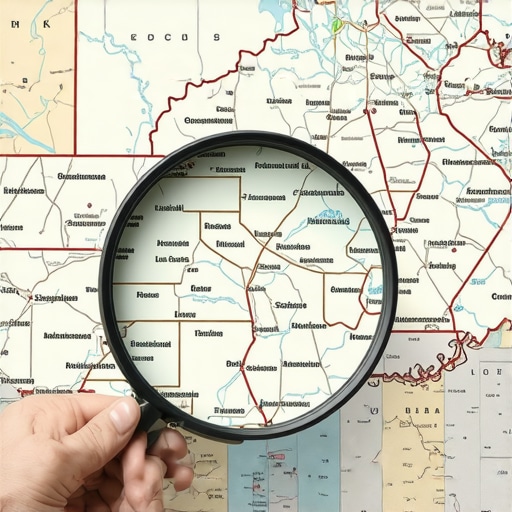
One of the most effective strategies we employ is the “Map Embed” technique. By embedding a custom Google Map on your city-specific landing page that shows your service radius or recent job locations, you create a powerful relevancy signal. This isn’t just about showing the user where you are; it’s about feeding the algorithm the geographic data it craves. When you combine this with localized service area business seo, you start to appear in the Map Pack for those “outer ring” suburbs. To truly improve google maps ranking, your website must act as a localized mirror of your real-world activity. Using specialized software to rank higher on google maps can help automate the tracking of these localized efforts.
The Map Embed Technique That Actually Sends Real Customers to Your Storefront
Advanced GBP Optimization for 2026: Beyond the Basics
By 2026, standard optimization – business name, phone number, and a few photos – is just the entry fee. To dominate the google map pack ranking factors, you need to leverage the advanced features Google has introduced to compete with social search platforms like TikTok and Instagram. The most significant of these is Video Reviews.
Our internal data shows a massive correlation between GMB ranking and the presence of video content within the “Updates” and “Reviews” sections. Google is prioritizing businesses that provide a “rich” user experience. When a customer in Paducah uploads a video review of your roofing job, it carries ten times the weight of a text review. It provides undeniable proof of location and service quality. This is one of the key “Video Review Fixes” for GMB ranking that we’ve seen work wonders for Kentucky contractors.
Additionally, you must utilize the “Services” and “Products” tabs with surgical precision. Don’t just list “Plumbing.” List “Emergency Water Heater Repair in Old Louisville” as a product. This allows your listing to appear in “Justified” search results – those little snippets that say “Their website mentions…” or “They offer…”. This level of google business profile optimization is what separates the top 1% of earners from those struggling to get the phone to ring. For those looking to scale this process across multiple locations, utilizing a professional google business profile optimization service is often the most cost-effective route.
5 Video Review Fixes for Your GMB Louisville Rank [2026]
Spotting Agency Malpractice: Ghost Leads and Fake Metrics
As the demand for local search optimization grows in Kentucky, so does the number of “fly-by-night” agencies promising the moon. One of the most insidious problems we see today is “Ghost Leads.” This occurs when an agency uses bot traffic to click on your “Call” button or “Website” link in your GBP dashboard to make it look like they are generating results. You see a spike in “Interactions,” but your bank account remains empty.
How do you spot this? Look at the “Direction Requests” in your Google Business Profile Insights. For an SAB, direction requests should be low (since you go to the customer). If an agency shows you a report with 500 direction requests to a hidden home office in a residential neighborhood, they are likely using bots to spoof your engagement signals. They are trying to trick the algorithm into thinking you have high “Prominence,” but this often leads to a hard suspension of your listing once Google’s spam filters catch up.
Real google maps ranking service providers focus on conversion, not just raw numbers. They should be able to show you recorded calls, form submissions, and actual revenue growth. If an agency cannot explain their strategy without using buzzwords, or if they refuse to show you exactly where your “leads” are coming from, it’s time to run. Always verify your rankings using independent google maps ranking service tools to ensure the data you’re being fed matches reality.
How to Audit a Kentucky SEO Agency for 2026 Ghost Leads
Conclusion: Reclaiming Your Service Area
The “Invisible Listing” problem is not a death sentence for your Kentucky business; it is a signal that your strategy needs to evolve. The days of “set it and forget it” local SEO are gone. In 2026, the winners will be the businesses that treat their Google Business Profile as a living, breathing extension of their service. By fixing your technical schema, producing hyperlocal content that proves your presence in cities like Lexington and Owensboro, and leveraging advanced signals like video reviews, you can break the Proximity Trap.
Don’t let your business remain a ghost in the very communities you serve. The Map Pack is the most valuable real estate in the digital world – it’s time you claimed your share of it. Whether you’re a solo contractor or managing a fleet of trucks across the Commonwealth, the steps outlined here provide the blueprint for dominance.
Ready to stop being invisible? Contact Louisville Local SEO today for a comprehensive audit of your Google Business Profile. Let’s put your business back on the map – literally.